Beyond the chart.
Reading the network that runs your family office.
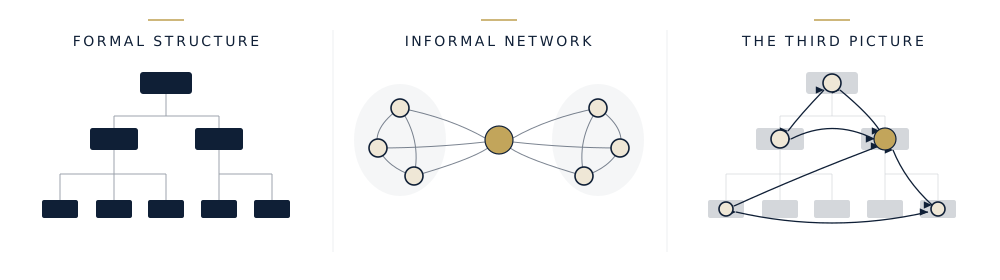
You know the tree. You know the chart.
either of them shows how the office actually runs. The family tree records who is related to whom; the org chart records who reports to whom. Both are necessary. Neither captures who people ask, who they trust, who quietly carries decisions across boundaries that the chart treats as separate.
That third picture has a name. Almost no family office has ever drawn it.
Family wealth is fragile by design.
These numbers may surprise you, but they describe a pattern that is often observed. The offices that endure are usually the ones that took governance seriously: disciplined structures, diversified allocation, rigorous legal frameworks, professional independent management, formal succession planning. Necessary. Not sufficient. Most multigenerational offices have answered those questions well. And yet the statistics persist.
The under-examined cause sits in the third picture: the relational fabric through which decisions, trust, and institutional memory travel. When that fabric thins across a generational handover, quietly and asymmetrically and without anyone noticing, the office that arrives at gen 3 is not the office that left gen 2.
Two questions in particular are easy to miss with a chart alone: who quietly carries trust across silos, and who connects camps the chart treats as separate. The same two kinds of people surface in every office.
Look at the office twice.
Bonding. Bridging. Two roles. The same office.
A senior staff role without equity or executive authority: perhaps an Independent Director, a long-tenured private secretary, a principal's chief of staff. By the chart, peripheral. By the network, the office's highest informal influence, touching every silo.
The case worth knowing. In the office we model in our demo, this is Catherine: a board appointee with no equity, who quietly outranks the entire family by network gravity. Her departure was in the plan. The office's structural anchor walking out alongside the founder is not a question the chart asked.
A generation-3 family member in a junior or specialist role: perhaps a sustainability analyst, a junior counsel, a family-foundation associate. By the chart, a leaf. By the network, the cross-cluster bridge nobody else at her seniority has.
The case worth knowing. In our demo office this is Maya, a niece chairing the Family Philanthropy arm. The formal three-slot succession plan doesn't name her. But every structural lens we ran (status, control, coalition, runway) puts her in the shortlist. The structural successor whose name the plan hasn't thought to write is often already doing the work.
These two roles appear in nearly every multigenerational office. The names change. The structural positions don't. And the two often act as each other's mutual buffer: losing either alone is recoverable; losing both in succession collapses both safeguards. The org chart never named that dependency.
Support the anchor. Cultivate the bridge.
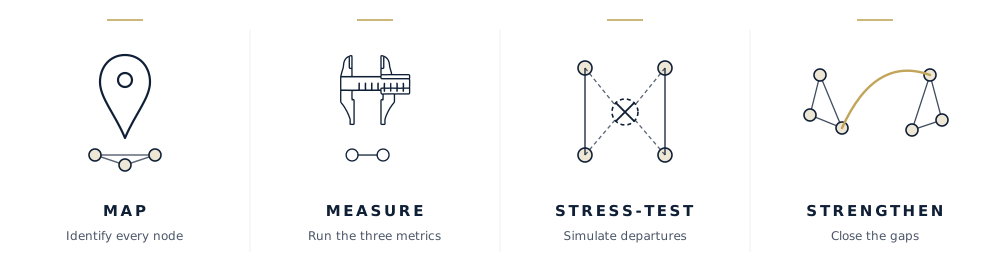
The framework is complementary to existing governance, not a replacement. The chart and the plan still answer the questions they were built for. The network adds two questions on top, and two corresponding moves.
Build redundancy around the anchor. Once the trusted insider is identified, the wrong move is to add more ties to them. That concentrates the office's dependency further. The right move is to recognise the role, protect the position, and deliberately build the structural alternatives so the office stops depending on a single person.
Add brokerage + closure to the bridge. Once the cross-silo connector is identified, the right move is to add the brokerage ties (cross-silo reach) and the closure ties (trust depth) their future role will require, before the moment of change, not during it. The same prescription that produces effective change agents.
Battilana & Casciaro (2013), HBR: "The Network Secrets of Great Change Agents."
This is the predictive value of the network. It surfaces who will hold succession, who will quietly defect, and where cohesion is already thinning, long before the formal process catches up.
The network is your family's long-lasting asset.
Fragile by default.
Wealth concentrates and dissipates. Relationships, when managed, compound. The first generation builds the office. The second runs it. The third inherits its relationships, or doesn't.
Predictive by design.
Network position anticipates who will lead next, who will quietly defect, and where cohesion is already at risk. The signals are present in the office long before they appear on the dashboard, in the legal filings, or in the boardroom.
Resilient by choice.
Healthy family-office networks are redundant and multi-hub. That redundancy is resilience. Auditing, diversifying, and formalising the relational layer converts invisible social capital into a managed asset. The discipline is not difficult. It is, however, deliberate.
The next conversation is over coffee.
If any of this resonates, we would welcome a (digital) coffee with SFO Alliance attendees who would like to talk through their own office in confidence: what's working, what's been quietly worrying you, what your network might already be saying. No deck. No agenda. Just a conversation.